
 Written by
Mictlantecuhtli (pronounced meek-tlan-te-coot-lee) is the Aztec “Lord of the Place of the Dead.” He reigns over Mictlan, the lowest and most northern section of the underworld.
Unlike the Christian concept of Satan, he is not an “evil” punisher of sin. He is simply the inevitable, skeletal destination for the majority of humanity—those who die of natural causes, old age, or common diseases.
His name translates to “Lord of Mictlan” in Nahuatl, the language of the Aztecs. Other epithets include Ixpuztec (“Broken Face”), Nextepehua (“Scatterer of Ashes”), and Tzontemoc (“He Who Lowers His Head”), reflecting his fearsome and skeletal nature. He was not merely a punisher but a maintainer of cosmic balance, overseeing the dead regardless of how they perished—whether from natural causes, heroic acts (like battle or childbirth), or otherwise.
Mictlantecuhtli was associated with symbols of the night and decay, such as spiders, owls, bats, the northern direction (Mictlampa, the “region of death”), and the 11th hour of the day. In the Aztec calendar, he was linked to the day sign Itzcuintli (dog), provided souls for those born on the sixth day of the 13-day week, and was the fifth of the nine Night Gods. He also served as a secondary Week God for the 10th week of the 20-week cycle, symbolizing the interplay of light and darkness alongside the sun god Tonatiuh. In some codices, like the Codex Vaticanus 3738, he is labeled as “the lord of the underworld, Tzitzimitl,” connecting him to demonic entities.
His appearance is one of the most striking and terrifying in Aztec iconography.
He is almost always depicted as a blood-splattered skeleton or a person with a skull for a head. Uniquely, his skull often retains its eyeballs, which bulge out, symbolizing his ability to see in the gloom of the underworld.
In sculptures (like the famous ceramic statue in the Templo Mayor museum), a large, liver-shaped organ often hangs from his ribcage. To the Aztecs and their ancestors the Atlantin people, the liver (elli) was a seat of souls and passions, intimately connected to the underworld.
His headdress featured owl feathers and paper banners, and he wore a necklace of human eyeballs, earspools made from bones, and sandals denoting high status.
His arms were frequently raised in a threatening pose, as if ready to rend the dead apart. In codices, his open skeletal jaw symbolized swallowing stars during the day.
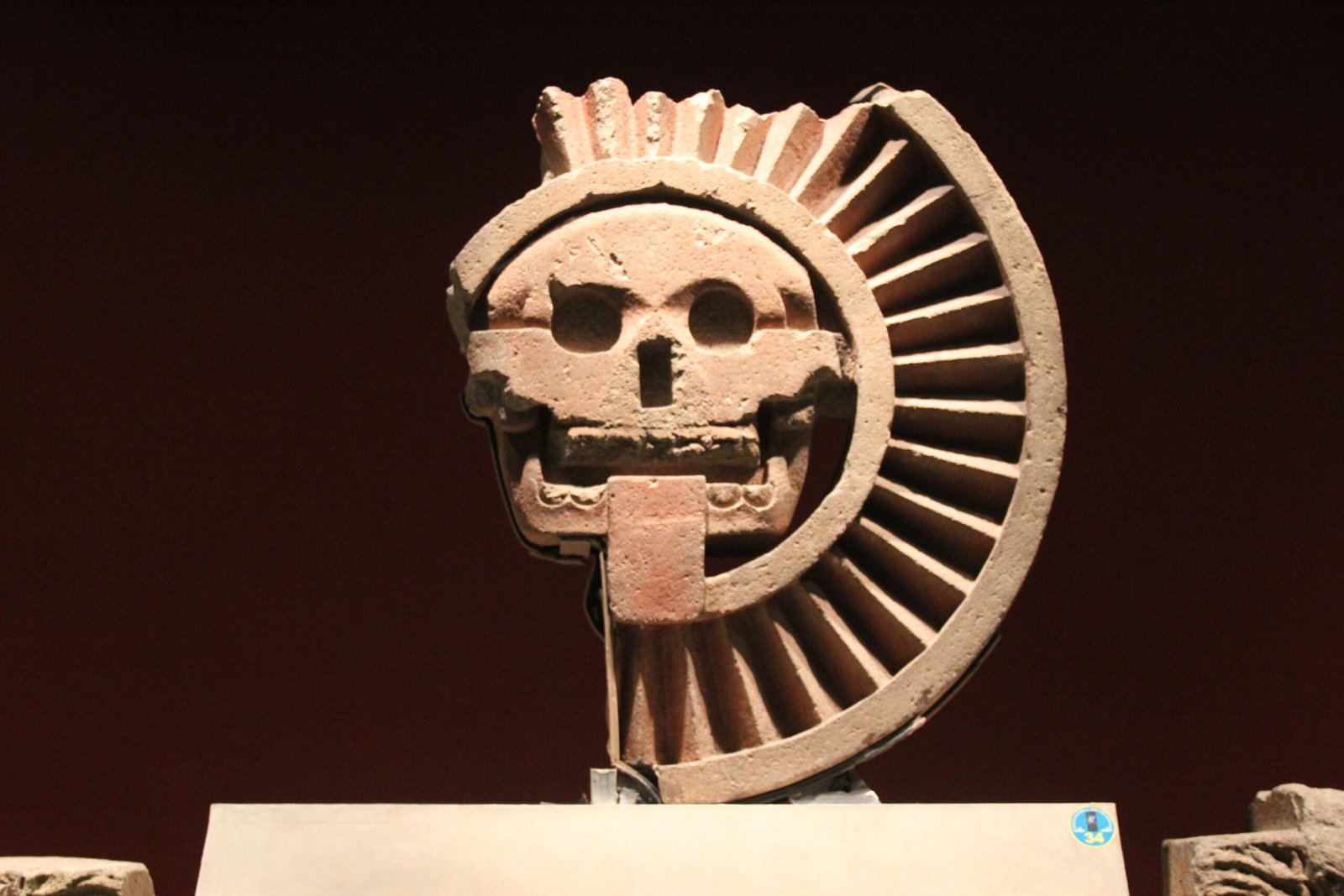
Despite the macabre imagery, skeletal motifs in Aztec art also represented fertility, health, and abundance, blurring lines between life and death. Notable artifacts include life-size clay statues that flanked entrances to the House of Eagles near Tenochtitlan’s Great Temple, and a stone disk from Teotihuacan depicting a similar death figure.
The Kingdom of Mictlan
Mictlantecuhtli rules over a dark, windowless realm. It is not a place of torture, but of apathy, difficult trials, and eventual nothingness.
When a person died a “common” death (not in battle or childbirth), they did not go to Mictlantecuhtli immediately. They had to undergo a grueling four-year journey through nine distinct levels of the underworld in order to retrieve the lost pieces of their soul.
The soul had to cross rivers of blood, endure wind that blew obsidian blades, and evade mountains that crashed together to crush travelers. This was like a dark version of the Astral Planes.
This is why Aztecs were often buried with a Xoloitzcuintli (Mexican hairless dog). The dog served as a spirit guide to help the master cross the first river, the Apanohuaya.
Only after completing this journey would the soul reach the ninth level (Chicunauhmictlan), where they would present gifts to Mictlantecuhtli. He would then say, “Your sorrows are ended,” and the soul would be allowed to dissolve into nothingness—The Big Sleep.
The Myth of the Bones (Creation of Man)
Mictlantecuhtli plays the antagonist in the famous myth of human creation.
After the destruction of our previous world (which was the Fourth Sun, Nahui Atl), the creator god Quetzalcoatl (also spelled Ketsalkoatl) needed the bones of the ancestors to create a new race of humans. He descended into Mictlan to ask Mictlantecuhtli for them.
Mictlantecuhtli agreed, but only if Quetzalcoatl could blow a conch shell trumpet four times around his circle. The catch? The shell had no holes. Quetzalcoatl used worms to bore holes and bees to create a buzzing sound, tricking the death god.
Furious at being outsmarted, Mictlantecuhtli ordered his quail minions to attack. Quetzalcoatl panicked, tripped, and shattered the bones he was carrying.
Quetzalcoatl escaped with the broken fragments. Because the bones were broken into different sizes, this explains why humans today come in all different heights and shapes.
Family and Worship
He rules alongside his wife, Mictecacihuatl (Lady of the Dead). She is the protector of the bones of the dead and presides over the festivals of the dead. She is considered the ancient root of the modern “Santa Muerte” figure and the traditions of Día de los Muertos (the day of the dead).
Mictlantecuhtli resided in a windowless house in Mictlan with his wife and counterpart, Mictecacihuatl (Lady of the Dead). Together, they represented the opposites and complements to the life-giving deities Ometecuhtli and Omecihuatl.
Mictlan itself was a cold, gloomy realm divided into nine levels, where most souls journeyed after death (except those destined for other afterlives, like warriors going to the sun or drowned souls to Tlalocan). The journey to Mictlan took four years, involving trials like crossing rivers, mountains, and facing beasts, after which souls reached eternal rest under Mictlantecuhtli’s rule.
Worship of Mictlantecuhtli sometimes involved ritual cannibalism in the temple precincts, symbolizing the consumption of life by death.
Worship of Mictlantecuhtli was intense and tied to the Aztec emphasis on death as part of life’s cycle. He was particularly honored during the month of Tititl in the Aztec calendar. Rituals often involved human sacrifice, where a priest or impersonator dressed as the god was killed. More gruesomely, some ceremonies included ritual cannibalism, with human flesh consumed in temples dedicated to him to honor the dead and ensure cosmic order. Temples to Mictlantecuhtli were sites of these offerings, reflecting the Aztecs’ belief in feeding the gods to sustain the world.
Counterparts in Other Mesoamerican Traditions
Maya: Ah Puch (also Yum Cimil, God K, or Kimi)
In Maya mythology, Ah Puch was the primary god of death, ruling Metnal (or Xibalba), the deepest and most dreadful level of the underworld. Like Mictlantecuhtli, he was depicted as a skeletal figure with bells on his hair and clothing (symbolizing the call to death), a bloated belly from decay, and sometimes owl motifs. He embodied death, darkness, disaster, and destruction but also regeneration, childbirth, and new beginnings—reflecting the cyclical nature of life. Ah Puch was infamous for luring people to their doom at night and was a key antagonist in the Popol Vuh, where he tests heroes in Xibalba. He directly corresponds to Mictlantecuhtli as a ruler of the dead, with similar roles in judging or hosting souls.
Zapotec: Pitao Bezelao (also Pitao Pezeelao or Kedo)
The Zapotecs, centered in Oaxaca, venerated Pitao Bezelao as their god of death, the underworld, and the earth. He was also associated with masculinity, fortune, good harvests, luck, and protection of land and crops—showing a multifaceted role beyond mere death, perhaps as a fatherly figure overseeing life’s end and renewal. Depictions are rare but often show him as a skeletal or masked entity. Mitla, a major Zapotec site, was a center for his cult, believed to be an entrance to the underworld. Some sources refer to him as Kedo, a god of death, justice, and evil, but Pitao Bezelao is the more commonly cited name for the primary death deity. This parallels Mictlantecuhtli’s role as underworld lord, though with added agricultural ties fitting Zapotec farming society.
Mixtec: Equivalent Death God (Often Syncretized with Mictlantecuhtli)
The Mixtecs, neighbors to the Zapotecs and Aztecs, shared similar underworld concepts and often depicted their death god in ways indistinguishable from Mictlantecuhtli due to cultural intermingling. Artifacts like a 14th-15th century gold pectoral from Monte Albán’s Tomb 7 show a skeletal figure with Mictlantecuhtli-like features, suggesting adoption or equivalence. In Mixtec codices, death deities appear as skeletal beings ruling an underworld, associated with fertility and cycles, much like in Aztec lore. While no unique Mixtec name is prominently documented (they used calendar-based names like “1 Death”), the deity functioned similarly, overseeing the dead and symbolizing transformation.
Purépecha (Tarascan): Tihuime (or God of Hell)
The Purépecha Empire in western Mexico had Tihuime as their god of death and the underworld, equivalent to Mictlantecuhtli. Details are sparse, but he was honored with sacrifices, including skin removal rituals during the Cuingo celebration. The Purépecha underworld involved souls watching over the living, especially during death festivals. Some sources mention a “God of Hell” without a name, but Tihuime is cited as the direct parallel. Unlike the Aztecs, Purépecha mythology emphasized fire and sun gods more, but Tihuime maintained order in the afterlife.
Otomi: Hmüšithü
The Otomi people, north of the Aztecs, had Hmüšithü as their death god, a direct counterpart to Mictlantecuhtli. Little is detailed in sources, but he ruled an underworld and embodied death’s inevitability, fitting into broader Mesoamerican patterns.
Summary Comparison
| Feature | Detail |
|---|---|
| Name Meaning | Lord of the Place of the Dead |
| Domain | The 9th Level of the Underworld (North) |
| Major Myth | Tricked by Quetzalcoatl over ancestral bones |
| Symbols | Skull, Liver, Owl, Dog, The Number 9 |
Animals
His animals are the owl (a bird of omen), the spider, and the bat.
