 Written by
The sign of Lamat (Venus) in the Mayan Tzolk’in calendar is an extraordinary symbol of duality. It sits at the intersection of two distinct, opposite archetypes: the Priest-King (associated with the planet Venus) and the Rabbit (associated with the Moon, fertility, and intoxication). This duality creates an inner struggle.
The story of the Toltec ruler Topiltzin Quetzalcoatl is the perfect mythological dramatization of this struggle. His life arc—from a chaste priest to a drunken “sinner”, and finally to a celestial god—maps directly onto the “Higher” and “Lower” frequencies of the Lamat sign.
The Two Sides of Lamat
To understand the story, we must first understand the conflicting energies within the Lamat/Venus sign itself.
- The Higher Side: The Star (Quetzalcoatl/Venus)
- Symbolism: Sovereignty, harmony, artistic beauty, and spiritual leadership.
- The Archetype: This is the “Priest-King.” It represents the discipline required to rule oneself and others. In this aspect, Lamat is the bright Morning Star that heralds the sun—a beacon of hope and higher consciousness.
- The Lower Side: The Rabbit (Tochtli)
- Symbolism: In Mesoamerican thought (specifically the Aztec tradition which parallels the Mayan Lamat), the Rabbit (Tochtli) is the sign of the Moon and the Earth’s abundance.
- The Trap: While the Rabbit represents fertility, it also represents overindulgence. The Aztec gods of alcohol were known as the Centzon Totochtin (the 400 Rabbits). This side of Lamat is “animalistic” not because it is evil, but because it is governed by sensory pleasure, drunkenness, and a loss of inhibition.
The Story: The Fall of the Priest-King
The legend of Topiltzin Ce Acatl Quetzalcoatl, the last ruler of the mythic city of Tollan (which symbolized royal Atlantean/Atlantin capital cities), serves as a cautionary tale about the Lamat/Venus struggle—synonymous with the struggle of the god, Quetzalcoatl. He began as the perfect embodiment of the “Higher Lamat” but was brought down by the “Rabbit.”
The High Priest (The Star)
Topiltzin Quetzalcoatl reigned as a “perfect” Priest-King. He was a master of the arts, a calendar keeper, and a pacifist who forbade human sacrifice, offering only snakes, birds, and butterflies. He lived in a state of purity and high discipline, remaining in sexual abstinence to retain his Tonalli (life force). He was the living avatar of the Morning Star—brilliant, distant, and composed.
The Intrusion of the Rabbit (The Temptation)
The chaotic sorcerer god Tezcatlipoca (Smoking Mirror) sought to topple Quetzalcoatl. He knew he could not defeat the King with force, so he used the weakness of the Lamat sign: pleasure.
Tezcatlipoca approached the aging, sickly King disguised as an old medicine man. He offered Quetzalcoatl a “medicine” to cure his ailments and make him young again. The medicine was pulque (fermented maguey sap)—the sacred intoxicant of the Rabbit gods.
The Animalistic Fall (The Drunkenness)
Quetzalcoatl, who had never touched alcohol, drank the pulque.
The “trick” did not end with the first cup of pulque. Tezcatlipoca knew that simple drunkenness wasn’t enough to destroy a god-king; he needed Quetzalcoatl to fundamentally betray his own nature. He needed to drag the “Star” down into the mud of the “Rabbit” so deeply that Quetzalcoatl could never forgive himself.
Here is how the deception unfolded after the first cup, and the tragic events that led to his exile.
The Trap: The Sister and the Broken Vow
Once Quetzalcoatl was intoxicated—giddy, weeping, and singing—Tezcatlipoca (often accompanied by other demon-sorcerers in the legend) executed the second phase of the plan.
He reminded the King of his sister, Quetzalpetlatl, a chaste priestess who lived in a sanctuary of absolute purity, doing penance on the mountain of Nonohualco.
- The Invitation: Tezcatlipoca suggested, “You should bring her here to share in this new joy.” In his drunken “Rabbit” state, Quetzalcoatl agreed, forgetting his sacred vows of celibacy and separation.
- The Shared Fall: Tezcatlipoca went to fetch Quetzalpetlatl, lying to her that her brother, the King, commanded her presence to give her a “new dignity.” When she arrived, she too was tricked into drinking the pulque.
- The Ultimate Transgression: Intoxicated and stripped of their higher judgment, the brother and sister fell asleep together. They committed incest (or simply broke their strict vows of chastity), engaging in the carnal acts they had sworn to transcend.
This was the true victory of the “Animal” side. The Priest-King didn’t just get drunk; he desecrated his bloodline and his priesthood.
The Morning After: The Silence of the Star
The tragedy of the Lamat sign is that the “Rabbit” phase is temporary, but the “Star” consciousness always returns.
- The Forgotten Ritual: The next morning, the sun rose, but Quetzalcoatl did not. For the first time in his life, he missed the morning rituals. The palace was silent.
- The Awakening: When Quetzalcoatl finally woke up, the alcohol had worn off. He looked at his sister, and she looked at him. The crushing weight of reality hit them. The “Animal” had had its fun, and now the “Priest” was left with the wreckage.
- The Lament: He felt a profound sense of “spiritual rot.” He famously cried out, “Nican niquetzalcoatl” which translates to “Here I am, I’m Quetzalcoatl” —or more despairingly— “Ca nimitztlazotlaz, in tlalticpac!”
(“How I loved the earthly realm!”) acknowledging that the fault was his own. He realized he was no longer a god walking on earth, but a flawed, dirty man.
The Desolation of Tula: Before the Departure
Before he physically left the city of Tula, Quetzalcoatl performed acts that symbolized the end of his Golden Age. He dismantled his kingdom, ensuring that if he couldn’t rule it with purity, no one else would inherit its glory.
- Burial of the Arts: He took his incredible treasures—jade, turquoise, and precious feathers—and buried them deep in the ravines and riverbeds. This symbolized that the “Higher Knowledge” (the Star aspect) was going into hiding.
- Transformation of Nature: According to the legend, his grief was so powerful it warped the land. He burned his palaces of gold and coral. He turned the cacao trees (symbols of wealth) into mesquite bushes (symbols of the arid wasteland). He ordered the colorful birds to leave the valley.
- The Stone Seat: He went to the edge of the water and sat on a stone. He wept so bitterly that his tears bore holes into the rock, and the imprint of his hands and buttocks was left in the stone—a permanent mark of the “Human” suffering of the god.
The Decision to Leave
He gathered his few remaining loyal followers (dwarves and hunchbacks, symbols of the marginalized) and declared that his time was over. He announced he was going to Tlillan Tlapallan (The Land of Black and Red—the land of wisdom and death) to burn himself and be reborn.
Tezcatlipoca (rumored to have played a pivotal role in the destruction of Atlantis) had succeeded in driving him out, but inadvertently, he had set Quetzalcoatl on the path to his final transformation: from a fallen King on Earth to the eternal Venus in the sky.
The Symbolic Meaning
In the context of the Lamat sign, this story teaches that true “Rulership” (The Star) is earned only through the mastery of the “Animal” (The Rabbit).
- The Rabbit (Lower Lamat): Represents the magnetic pull of the material world. It is the abundance that leads to rot, the party that never ends, and the loss of consciousness through pleasure.
- The Priest-King (Higher Lamat): Quetzalcoatl had to “burn away” his physical vessel (the part of him that could get drunk and sin) to become the Star.
We all can relate to Quetzalcoatl and the Lamat/Venus sign: we have the potential to be a shining star (conscious, artistic, spiritual), but we are constantly tested by the Rabbit (distraction, addiction, sensory overload). The “Fall” is not the end of the story; it is the catalyst that forces the consciousness to ascend from the physical plane to the spiritual plane.
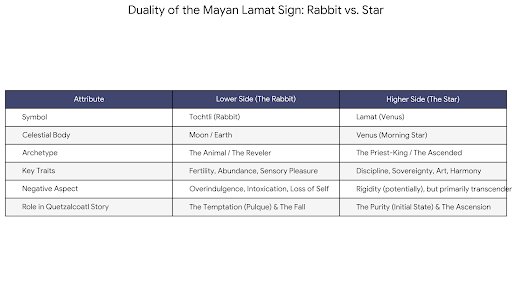
The chart above breaks down the duality of the Lamat sign, contrasting the “Lower” Rabbit aspect with the “Higher” Star aspect as symbolized in the Quetzalcoatl legend.
Key Takeaway from the Chart
The most critical distinction is between Abundance (Rabbit) and Harmony (Star).
- The Rabbit represents the chaos of abundance—too much sensation, too much pleasure, and the loss of boundaries (intoxication).
- The Star represents the order of beauty—discipline, artistic creation, and the clear boundaries required for rulership.
In the story, Quetzalcoatl could not simply remain the Star; he had to experience the dark, unconscious polarity of the Rabbit to understand his shadow self, fall into a dark night of the soul, and then ascend out of it as a higher form of the Star (the planet Venus) that transcends death and is immortal. This suggests that the “Lower” side of the rabbit -also associated with Tezcatlipoca/Itztli) isn’t simply a “trap”, but a necessary hurdle set by higher powers to overcome for spiritual growth/enlightenment.
Conclusion
The story of Quetzalcoatl’s downfall symbolizes the inner transformative journey of those born with the Lamat/Venus day sign. This sign isn’t about being like a rabbit, it’s more about being like the ruler Quetzalcoatl – like the star Venus. The rabbit side represents the struggle of this sign and abundance on a more earthly level, whereas the star Venus and the god Quetzalcoatl represent the sign and it’s attributes like abundance on the higher, spiritual level.
